Sociophonetics
An Expression of Linguistic Oppression in Peruvian Culture
Words:
Maria Paula Guzmán
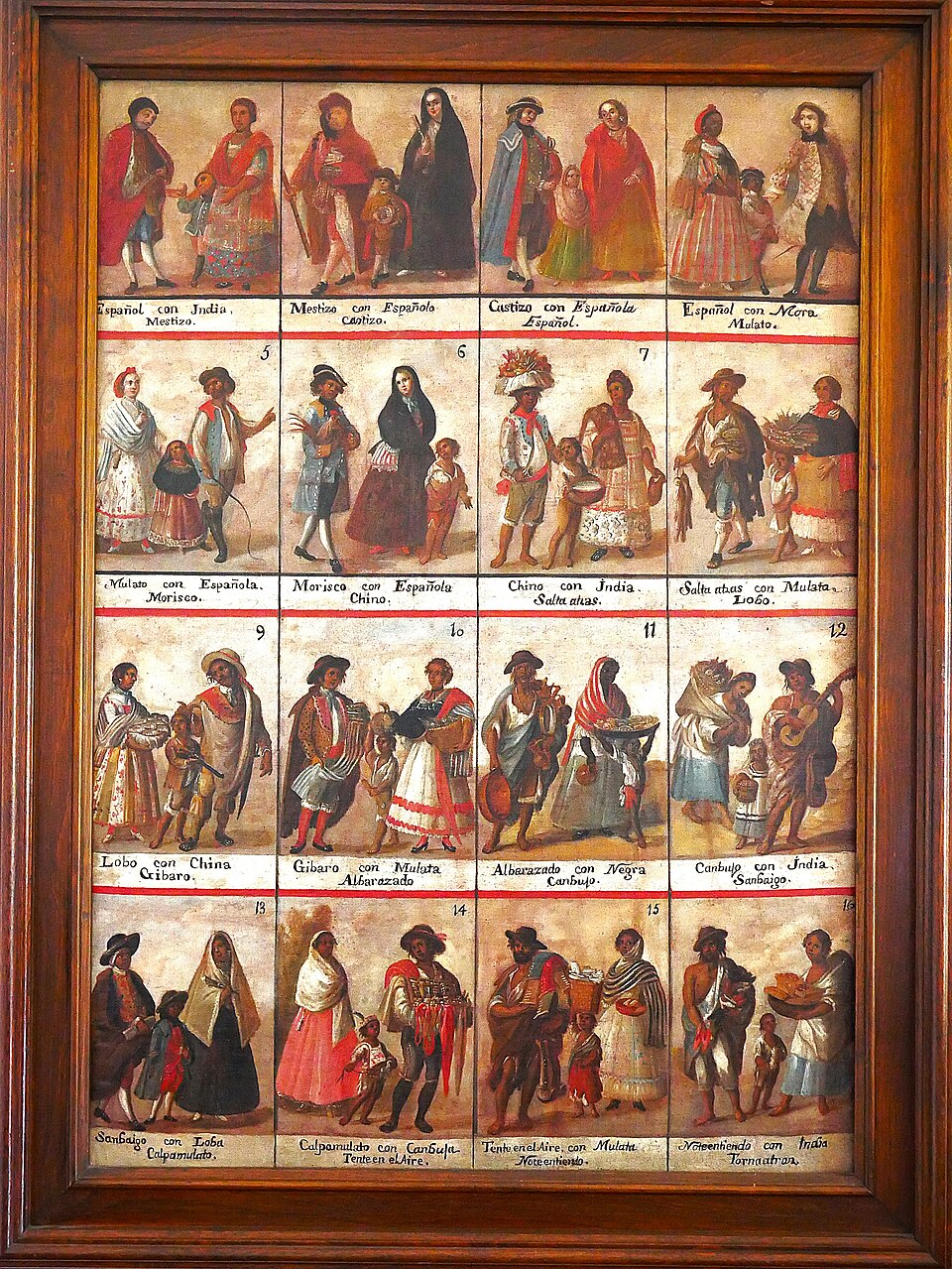
Image caption: Anonymous (s. XVIII). Casta painting [oil on canvas]. National Museum of the Viceroyalty, Tepotzotlán, Mexico.
2 February
“Ultimately, this relentless drive toward [linguistic] homogenisation does not merely standardise speech; it reproduces the colonial fantasy of 'cleansing' the self to fit an ever-shifting ideal.”
Maria Paula Guzmán
 01.
01.“La”
My grandfather, like many provincial children in Peru, was indoctrinated with the belief that the finest education available to him was to be found in Lima. Far from his home in Yungay, Ancash, my great-grandmother saved every penny to send him to the most prestigious public boarding school in the capital: Colegio Nuestra Señora de Guadalupe. Located on Alfonso Ugarte Avenue in central Lima, the sky-blue building possesses an architecture so imposing it feels larger than the very block it occupies. It is a place of legend, the alma mater of the literati, politicians, and "people of renown" who shaped the nation.
It was there that he first encountered racism. It was not due to his skin tone, for he could pass unnoticed among the light-brown, cinnamon-skinned Limeños, but because of his speech. Having grown up speaking Quechua, his command of Spanish was limited; it was at school that he had to learn to speak "proper" Spanish. He often told me how his "countryman’s accent" (acento de paisano) betrayed him, making him the target of mockery by the privileged Lima elite who sat beside him in class. The internado (boarding school) was reserved for students from the provinces, and it was there, amongst peers facing the same struggle, that he found his lifelong community.
Years later, at university, a professor, a renowned former military officer and decorated spy, proudly mentioned he was a Guadalupano [1]. Hoping to find a point of connection, I told him my grandfather had also attended the school. When I mentioned he had been in the internado, the professor’s expression shifted. "The internado was for paisanos" [2] he replied dismissively. I stopped asking questions then. It was a painful realisation: the grandfather I admired had been a target of the very discrimination I was now studying.
Growing up, I always believed that the most vital aspect of speech lay in the words themselves. In my adolescent imagination, eloquence was something constructed with high-sounding adjectives, words far removed from the everyday vocabulary of the public. I believed that sounding 'educated' was simply a matter of lexicon, largely because I grew up watching my grandparents, both schoolteachers, speak with immense eloquence. My grandfather, a writer, would use words I didn't yet understand to describe things in the most beautiful way possible.
I grew up listening to the radio, where a supposedly neutral tone of voice toyed with the endings of sentences, conveying a light, almost invisible sense of humour. It stood in stark contrast to the television: there, the news arrived bound by serious faces and rapid, monotonous words, creating an impression of suspense at the end of every sentence.
One day, I noticed that when my grandfather referred to elements of nature, he used feminine articles, such as 'la mar' (the sea) or 'la calor' (the heat). I once dared to correct him, telling him it was 'el calor', yet he persisted. At the time, I thought it was a simple mistake that anyone might make—confusing genders. It was only later that I realised this was his way of preserving an 'Andinism' in his speech. The school system had indoctrinated him to speak like a 'proper' Limeño: with a slow, serene accent and bombastic words. This was reinforced by university and the schools where he taught—an entire system dedicated to 'speaking well'. Now that he is retired, I have never heard him speak as much Quechua as he does now, frequently using feminine articles with an intonation that sounds like a lament or an expression of historical suffering.
I find a powerful symbolism in this. Andean people learnt Spanish through Catholic prayers during the Conquest, repeating what their masters said and how they said it. They acquired the language within a context of oppression and slavery.
The Cleansing of the Pharynx
The colonial obsession with "cleansing" was born during the Conquest and will remain alive until the end of prejudice itself. Just as the Spanish colonisers imposed the idea of "cleansing the race" (limpiar la raza) to ascend the social pyramid, manifested through the sistema de castas (caste system), every individual was labelled by their skin colour and that of their parents. Occupying the first rank was the union of a Spanish man and an Indigenous woman, whose child was termed a mestizo.
It was within Republican society that the "cleansing of speech" was imposed.
This is where the phenomenon of Linguistic Passing emerges. In a country with such marked hierarchies, a person may possess physical traits that allow for whitepassing, yet this pass is merely provisional. If, upon opening one’s mouth, the accent reveals an Andean or Amazonian origin, the system of oppression is immediately triggered.
The standard Lima accent acts as the definitive seal of belonging; it is the shield that frees you from being the target of discrimination. If you speak "well", it is assumed you are gente decente ("decent people") a historical euphemism used to designate those who were not born to serve (Carrasquero 2010)
Shirley Cortez González, a Language professor at the University of Piura, documented a case that encapsulates this phenomenon: a university lecturer "advised" his non-capital city students to speak like Limeños to achieve success and leave a worthy legacy for their families (Cortez 2021).
This "advice" is the essence of symbolic violence. By labelling variants influenced by Quechua as "deformed" or "impure" forms, the speaker is stripped of their dignity. The encounter between Lima Spanish and migrant varieties is not a dialogue; it is an antagonistic clash where the mote (the Andean-inflected accent) is treated as an error that threatens the social order.
Sociophonetics thus allows dominant groups to perform a "status prediction" with only listening.
Architecture of Sound
Historically, the variety of Spanish from the central coast, particularly that of Lima, has been established as the model of national prestige. It is perceived by 48 per cent of speakers as the region where the "best" Spanish is spoken, due to a supposed "superior pronunciation", an "absence of accents" (dejos), and the fact that it is largely uninfluenced by Indigenous languages (Arias 2014).
According to Escobar (1978), this phenomenon in Lima is a direct result of its configuration as a hub for internal migration. Here, "Coastal Spanish" (Tipo 2), characterised by yeísmo, coexists with Andean varieties (Tipo 1) and the interlanguage of bilingual Quechua or Aymara speakers. Within the capital itself, this differentiation is far from uniform; speech acts as a precise marker of both district origin and level of education. Jury-based evaluation studies have demonstrated that residents can distinguish voices from wealthy residential areas such as Miraflores or San Isidro from those of working-class sectors like La Victoria or El Callao (Escobar 1978).
In phonic terms, prestige is associated with specific traits, such as the aspiration of the post-nuclear /-s/ in middle-to-upper strata (pronouncing /mójka/ instead of mosca). Conversely, traits like the hesitation between vowels "e/i" and "o/u"—typical of native Quechua speakers—are severely stigmatised (Cortez 2021). This sociophonetic stratification reveals that middle-class groups often exhibit greater linguistic insecurity as they attempt to emulate elite speech to distance themselves from the working class. Meanwhile, "barrio" or street slang occasionally emerges as a defiant response of youthful identity against the imposed norm (Escobar 1985; Carrasquero, 2010).
Ultimately, this differentiation persists because society uses "speaking well" as an ideological sieve to exercise mechanisms of exclusion, mockery, or integration. This has reached the point of documented cases where students are advised to "speak like Limeños" simply to avoid discrimination (Cortez 2021; Escobar 1978).
The relaxed drawl of the upper class
My parents, acutely aware of these class divisions, saved rigorously to send me to an elite private school. Within the hierarchy of such institutions, mine was perhaps considered the 'lowest' of the elite, yet it was situated in an exclusive pocket of San Isidro where admission required both personal references and interviews.
Upon entering, I realised that almost all the girls already knew each other; they had attended the same nido—the prestigious preschools where children are networked long before they enter these religious private institutions. I was at a disadvantage from the outset. Only four or five of us lacked that pre-established connection.
Whether I wish to deny it or not, this was the environment that shaped me. I grew up amongst classmates who spent their summers at exclusive beaches, carried the latest iPhones, and wore 'Kids' (a high-end Peruvian brand). While I wasn't fully part of this bubble, I existed in a kind of limbo—suspended like the soapy film on a bubble wand, where only the air exhaled or inhaled could determine my form.
Later, at an English language institute, a girl called me a 'pituca ridícula' (a ridiculous snob). She told me I dressed far too poorly to be 'speaking like that'. I couldn't understand her comment at the time; I saw no difference between her words and mine. It was only at university that the scale of this differentiation became clear: the realisation that a single word can sound different, and therefore mean something entirely different, depending on who says it.
The standard of "pituco" speech has not been static. If we look back, the pituco antiguo of the 1950s pursued an ideal of academic neutrality: a standardised Spanish free from exaggerations or phonetic distortions. It was the voice of an elite that sought to sound universal, European, and sober.
A quintessential example of this is found in the interviews of the legendary singer-songwriter Chabuca Granda. Although she was born in Cotabambas, in the department of Apurímac, she became the hallmark of the neutral Lima accent. Her manner of expression was celebrated not for its exclusion, but for its refined poise. In her voice, the "cleansing" of the pharynx was achieved through a sophisticated lyricism that defined the high-society standard of her time, a sharp contrast to the contemporary elite's speech (TVE 1977)
In contrast, the modern-day pituco has deformed phonetics towards an extreme relaxation. It is a way of speaking that stretches vowels and nasalises sounds, creating an acoustic distance from the working-class sectors. Interestingly, this accent has shifted from being the "ideal" to becoming an object of national parody. The popularisation of urban, "barrio", or marginal culture has tipped the scales. Today, the pituco accent is frequently ridiculed on social media as a sign of vacuity.
However, we must not mistake ridicule for a loss of power. Although there is a current trend of Indigenous reclamation and the pituco is mocked, the system of "sonic castes" has merely mutated. The new ideal of speech is no longer just "Lima-style cleansing", but Americanisation. Those who insert the most Anglicisms and demonstrate the best English pronunciation climb the new social pyramid.
We remain in a desperate search to avoid sounding like ourselves. Whether mimicking the nasal tone of an elite or the Spanglish of globalisation, the Peruvian continues to flee from their own sonic mestizaje. It is the same heritage that the professor in Piura sought to erase in order for his students to "become someone", the same heritage my grandfather continues to perpetuate with phrases like "la mar" or "la calor" among his warm accent.
Ultimately, this relentless drive toward homogenisation does not merely standardise speech; it reproduces the colonial fantasy of 'cleansing' the self to fit an ever-shifting ideal. To retain our local variations—to persist in saying 'la mar' or 'la calor'—is perhaps less a battle and more a sacred preservation of our ancestors' bond with the natural world. It is a refusal to let centuries of Andean wisdom fade into oblivion, ensuring that the patriarchal structures imported by the Conquest do not wither our Flor de Qantu—the sacred flower of Incan wisdom. What more is there to fear when our voices already carry the weight of historical suffering? The very cadence of Lima, with its lingering, sorrowful endings, is a sonic testament to a pain that has yet to be fully spoken. By reclaiming our accent, we are not just speaking; we are allowing our true history to breathe through the air.
1. It is a colloquial term for a former or current student of Colegio Nuestra Señora de Guadalupe.
2. A colloquial term literally meaning 'countryman'. In the Peruvian context, it is often used by urban populations to refer to individuals from the Andean highlands, frequently carrying a paternalistic or derogatory undertone that marks the speaker as an outsider to the capital’s elite.
References
Arias, A. (2014). Linguistic attitudes in Peru. Predominance of the Spanish of the central and northern coast. In A. B. Chiquito and M. Á. Quesada Pacheco (Eds.), Linguistic attitudes of Spanish speakers toward the Spanish language and its variants (Bergen Language and Linguistic Studies [BeLLS], Vol. 5, pp. 1185-1248). University of Bergen.
Carrasquero H., V. M. (2010). A case of sociophonetic variation: post-nuclear /-s/ in the contemporary Spanish of Caracas. Letras, 52(81), 181-208.
Chabuca Granda - Interview on A Fondo de Soler Serrano (TVE).avi (1977) [Video]. YouTube. https://www.youtube.com/watch?v=ITtak9MT_wo
Cortez, S. (October 13, 2021). Speaking like a Lima native. Castellano Actual; University of Piura. https://www.udep.edu.pe/castellanoactual/hablar-como-limeno/
Escobar, A. (1978). Sociolinguistic variations of Spanish in Peru. Institute of Peruvian Studies.
Escobar, A. (1985). Changes in Spanish in Lima society and speech. Linguistic Series, 1(11). Institute of Peruvian Studies.

Writer Bio
Maria Paula Guzmán, well known as Crisalida, is a Peruvian researcher and writer dedicated to exploring the intersections of language, social identity, and power
dynamics. With a degree in International Relations with a deep passion for diplomacy and the cultural landscape of Lima, her work focuses on decolonising linguistic narratives and giving voice to the diverse heritage of the Andes. Through her writing, she seeks to bridge the gap between academic sociolinguistics and personal storytelling by fostering a global understanding of contemporary Peruvian society.